A Journey Through Time: The Story of Brewery Cottage ...
Built around 1865, The Brewers Cottage (known then as Brewery Cottage) was possably the last property to be built in the village, and born out of Lord Tweedmouths attempt to reform its original inhabitant - the colourful rouge John Fraser.
John was a legendary illicit whisky distiller, born and raised on a small holding above Tomich known as Kirkfield, he had many a brush with the law and was a well known figure to the excise men. In an effort to reform John, Lord Tweedmouth built the new village of Tomich a brewery and provided this very cottage to house John as the official brewer, its close proximity to the burn being the ideal location.
For many years, and led by folklore we assumed that John Fraser (Sr.) lived in the cottage alone, however recent information provided by John’s great-great-grandson reveals a much richer and informed family history. We are increably grateful to David Honeyman for much of the information that follows:
By the 1881 census, Catherine Fraser (née Campbell) now a widow at age 39, was listed as the head of the house in Beauly. Formally classified as a pauper, she was living with her daughters, Catherine (11) and Johanna (9) both of whom were scholars.
‘John Fraser, more widely known as in Strathglass by the suggestive alias, 'The Brewer' died on Sunday at the ripe old age of 90. In his early days, John was a noted smuggler, and the stories he was invariably willing to relate over a dram, regarding this lively part of his long career, together with other out of the way characteristics gave him the reputation of being a bit of a character which made him a ‘lion’ in Glen Affric, which it was the duty of tourists and travelers that way to interview both for their mental and bodily refreshment.
Fraser was born at Achnaheglish, on the property of the Fraser of Culbogie, now known as the Guisachan Estate, and belonging to Lord Tweedmouth. He learned the trade of a brewer at Inverness, and thus qualified, he for many years made the north of Scotland an interesting, as well as an adventurous locality for the gauger. John had a number of associates in the smuggling business, and he used to relate with some degree of pride, that despite the vigilance of the excise, he had seen twenty horses bearing casks of smuggled whiskey going over Ben Van in one night. The purchasers came from Lochaber, Kintail and the west coast general, the excellence of the brew as well as the cheapness of the liquor, being known far and wide. In those days, whiskey was cheap in the district, and a fair drinker could get “fou” for fourpence this small sum being sufficient to purchase nearly a quart of proof spirit.
John was a successful manufacturer of the spirit, but he confessed to have seen the excisemen at his distillery to his cost, and to having in consequence paid a visit to Edinburgh where he spent much of the time in seclusion, He afterwards conducted in a more legitimate manner a brewery in Tomich, and he had been heard to tell with considerable a story, of how he had the best of some of his neighbours who had cast discredit on the strength of the beer manufactured by him, John made a special brew, and invited the scoffers quietly to super, He then produced the beer which was nearly as strong as aquavitae with the result that all the guests were soon overcome and had to spend the night on the brewery floor.
Some fifty years ago, John was removed, or as he put it, he went away from the brewery and took up his abode at the side of Ben Vae, [Beinn Mheadhoin?) refusing to accept the offer by his relatives of a more comfortable home, His hut was beautifully situated many miles from any other habitation, on the banks of a small lake. He sustained what he called a great loss some years ago when his hut and everything in it was burned down during his temporary absence from home. It was whispered as an explanation of his sorrowing for his old home that he had lost a good round sum of money on that occasion, the result of his “enterprise “as well as his thrift in early life.
He set about building a new shelter on the old site and in a few days he put up a new dwelling, rude enough in all conscience but showing a constructive skill of what the old man felt somewhat proud.
Some years ago, the writer of these lines paid a visit to the brewery in company of several others who were acquainted with his trait. The internal fittings of the hut were exceedingly primitive and convenience being studied before affect, the appearance of the place was very curious. On this occasion Johns mood took a romantic turn and he related the oft old storyof how he got married. In John’s temperament the dashing spirit of historical times in the Highlands seems to have re-appeared before flickering out and finding that true love was not running smoot, he followed the striking old-fashioned method of stealing his bride. His fancy was the daughter of a small farmer and a short courtship sufficed to win the lassies heart and get her consent to their immediate marriage.
So far, so well, but the girl’s parents scoffed at an alliance with the brewer and would on no account give their consent to the union. John was forbidden the house and vicinity, and there was no hope for him but to match clandestine meetings which were no easy matter considering the vigilance of the farmer, who was aware of the character with whom he had to deal. In desperation, one night John mounted his black pony Tommy and set out on a visit to his sweetheart, evidently with a purpose on his mind. A short distance from the house he made the pony fast to a tree and stalked the dwelling, To his delight his sweetheart was the first person he saw, and in a trice was at her side. She had in her stocking soles stolen out to get a “word” as she expected John might be about. Johns first question was “Are you ready to come along with me”, “Yes “was the ready reply “but I have no boots on, “never mind boots “John replied eagerly “the pony is at hand” and together they there and then set out for his Mother’s house where they were married as soon as possible afterwards, The pair lived very happily for many years.
Although John’s trade was a brewer it was known as we have said, that he distilled a “wee drappie” on the sly for many years after he had given over the brewing business and his wholesale transactions had ceased. The eye of the excise was continually fastened on his movements for a time, but he was generally successful in cheating the officers when he discovered them on his track. On one occasion he was coming down the glen with an “Anker “on his back when he recognized the well-known form of the Excisemen appearing in the distance. John immediately ran to river and carefully consigned his tank to the stream which was in flood at the time. Regaining the public road, he hurried on to keep up with the stream. With solemn face he was passing the Excise men when the latter asked “Where John, are you going in such a hurry”, “Oh, I am going to Beauly for a doctor, my wife is ill”, replied the unscrupulous smuggler and he passed on followed by the sympathy of the Exciseman. Continuing his journey till gauger disappeared, John then went down to the river and found the little barrel intact sailing down the flood to meet him.
Deer stalking had always been a great attraction for John but he had to gratify his sporting tastes in such a manner as not to attract too much attention. He, however used to boast that in his younger days, he was the greatest poacher in the North, and even in later years as a proof of his prowess among the deer he had himself photographed in the act of firing at a royal, the stuffed head of which ornamented the studios. His solitary existence became, as it has been said, widely known but his hut was a regular resort for tourists and others visiting Glen Affric. John was always ready with a cup of tea for ladies and still more ready in the case of gentlemen, to produce from his box a good glass of whiskey. No doubt his hospitality met with occasional pecuniary reward, as he had no other apparent source of income. From his exampled knowledge of roads and tracks of the Highland district surrounding Glen Affric and the north end of Strathglass, his evidence was sought for and given at great length in the cases between Lord Tweedmouth and Mr Winans.
He took a pride stating that no other man living was able to give the information he could as to the roads and right of way in the district. He had a wonderful memory, and unusual capacity for expressing himself in terse accurate English. It was in connection with the action presently pleading in the Sheriff Court that John came to Inverness a fortnight ago, his evidence been again required by Mr Winans. He caught a cold on the journey and being so affected with cancer of the stomach it was soon apparent that the complication would terminate his career. His evidence could not be given and he died in the Volunteer Arms Hotel on Sunday, after having the best medical attendance and every comfort. His remains are to be buried at Corrimorny the resting place of his ancestors.’
The End of an Era, and the Beginning of Folklore ....
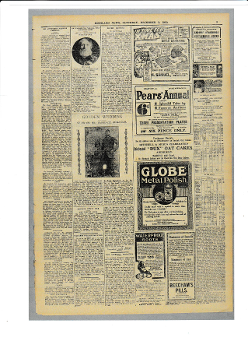
On Saturday 3rd December 1910 page 3 of the Highland News shows a photograph of a well dressed couple celebrating their 50th Wedding anniversary. The couple are Mr & Mrs Alexander Mackenzie of Guisachan. Mrs Mackenzie was noted as being the daughter of the famous John Fraser (Brewer), and that she had been born just about at 10 minuite walk from where she had spent most of her lifetime. The feature goes on to state her father (John) had been born there, her grandfather having come to Kirkfield Guisachen when quiet a youth. The couple had married in November 1860 at Kerrowwood, Kiltarlity by Rev. John Fraser. Two of their daugters were married and lived in Inverness, and one was living on the Breadabane Estates in Perthshire. One of the couples 5 daughters had died in infancy, and another more recently. the couple had 17 grandchildren.
(Photocopy below)
On June 7th 1955 at 6:15am, Johanna Campbell McKenzie (the widow of Kenneth John McKenzie, a Master Tailor) passed away at 16 Lovat Road, Inverness, at the age of 83. Her death certificate lists her parents, identifying her father, John Fraser (Jr.), as an Ordnance Surveyor. Her cause of death was a cerebral haemorrhage of 2 days. Her son (whose first name is illegible on the document), residing at 24 High Street, Fort William, was present at her passing.
After John Fraser left the brewery it fell into a state of disrepair, however the cottage became home to Duncan Kennedy, a retired gamekeeper from Cougie until his passing in May 1939. Duncan had come to Guisachan some 85 yeras earlier with his father. Duncans sister Dolly also lived in the cottage. This is some research that we will undertake in the future, if you are a relative of Duncan or Dolly please do get in touch we would love to hear from you.
We believe another John Fraser resided in the cottage, as did Stuart Grants brother.
The Brewers Cottage today
We consider ourselves merely the current guardians of this storied home, we are always looking to piece together more of its history, and we warmly welcome any stories or historical information our readers might wish to share.
The Brewers Cottage. Tomich, Near Cannich, Inverness-shire. IV4 7LY
STL Number HI-50494-F
Translate This Page